What Hidden Customer Demand Looks Like and How to Find It
Every business wants to grow, but growth often stalls because the obvious customers have already been reached. The customers who are easy to find and easy to convert are usually already buying from someone. Real growth comes from demand that is not yet visible: people who need what you offer but have not found it, or who have not realised they need it yet. Finding that hidden demand is what market intelligence does, and it is the core of a practice called market opportunity analysis.
Market opportunity analysis is a structured way to look at a market and see where demand exists without a matching supply. It is not the same as market research, which tells you what people say they want. Opportunity analysis looks at what people actually do: where they search, what they click, where competitors are weak, and which locations or customer segments are underserved. When you combine those signals, you get a map of untapped demand.
Why Visible Demand Is Only Part of the Picture
Public data such as search volume, social media mentions, and competitor pricing all point to activity that is already happening. That is useful, but it only shows you the surface. Below that surface are customers who search in different terms, who buy from local suppliers because they cannot find a national option, or who give up looking altogether because the market seems empty. Market intelligence digs into those deeper signals.
For example, a business that sells home renovation supplies might see high search volume for "kitchen countertops" in a city. That is visible demand. But market opportunity analysis might reveal that searches for "custom quartz countertops near me" have doubled in the past year while only one local supplier runs ads for that term. That gap between search growth and local supply is untapped demand. The business that sees it first can capture it before competitors even notice.
The Signals That Reveal Untapped Demand
Market intelligence tools pull together several types of data to build a picture of opportunity. Each signal tells part of the story, and the full picture comes from combining them.
Search Intent and Local Search Patterns
When people search with phrases that include location qualifiers such as "near me" or a city name, they are showing high purchase intent. They are not just browsing; they are looking for somewhere to buy. If a business sees that search volume for a product or service is rising in a specific area, but few or no businesses are actively targeting that area, that is a direct signal of unmet demand.

Local search data also reveals seasonal patterns. A landscaping company might see that searches for "snow removal service" start climbing in October in one region but not until November in another. That difference tells the business where to prepare marketing campaigns early and where to wait. Timing is part of opportunity; being first in front of a searcher often determines who gets the call.
Competitor Activity and Gaps
Looking at what competitors are doing is useful, but looking at what they are not doing is more valuable. Competitor analysis in market intelligence examines which keywords competitors bid on, which locations they serve, and which customer segments they ignore. A competitor that dominates a city might focus only on high-budget clients, leaving mid-range customers underserved. Or a competitor might run ads for one product line but completely ignore a related product that its own customers search for.
Those gaps are opportunities. And they are not always small. Sometimes the largest growth opportunity for a business is simply a product category or a geographic area that every competitor has overlooked. Market opportunity analysis makes those gaps visible by comparing competitor coverage against actual search demand.
Customer Segments That Are Not Buying Yet
Not all customers look alike. Market intelligence tools can segment audiences by behaviour: people who visited a competitor's site but did not buy, people who searched for a product but clicked no ad, or people who abandoned a purchase at the checkout page. Each of those groups represents a different kind of untapped demand.
For instance, a business that sells software for small retailers might find that many small retailers search for "inventory management app" but then leave because the top results all target large enterprises. Those searchers have a clear need, but no supplier is speaking to them. Targeting that segment with the right message and price point can open a new revenue stream that competitors have ignored.
How Opportunity Scoring Works
Once signals are collected, the next step is to score each potential opportunity. Opportunity scoring ranks opportunities by how much demand exists, how hard it would be to capture, and how well it fits the business's strengths. A high-score opportunity might be a city where search demand is high, competition is low, and the business already has a logistics presence nearby. A low-score opportunity might be a product category with strong demand but razor-thin margins and many established players.
The scoring is not a single number; it is a comparison. A business with a strong local brand might score higher on local opportunities than on national ones. A business with a flexible supply chain might score higher on seasonal opportunities. The point is to turn raw data into a prioritised list of actions, not a vague sense of where to go next.
Tools like those offered at webrankdigital.com help businesses collect these signals and run opportunity scoring automatically. Instead of spending weeks pulling data from multiple sources, a business can see a dashboard that ranks markets by potential. That saves time and removes guesswork from growth decisions.
From Analysis to Action
Identifying untapped demand is only the first step. The real value comes from acting on it. Market opportunity analysis should lead to concrete decisions: which new location to open, which customer segment to target with a specific campaign, which product feature to prioritise, or which competitor weakness to exploit.
For a multi-location business, the analysis might show that one neighbourhood has twice the search demand of another but only half the ad coverage. That is a clear signal to shift advertising budget. For a service business, the analysis might show that a particular customer segment searches for a problem solution at a certain time of year, meaning the business can time its outreach to catch them at the moment of need.
The analysis also helps avoid bad bets. If a market looks attractive on the surface but opportunity scoring reveals high customer acquisition costs or strong competitor loyalty, the business can steer resources to a better opportunity. That kind of discipline separates businesses that grow steadily from ones that chase every trend and burn through their budget.
What Market Intelligence Cannot Do
Market intelligence is a powerful tool, but it is not magic. It cannot tell you exactly which customer will buy or guarantee that a new product will succeed. What it does is reduce uncertainty. It replaces hunches with data. It shows where the evidence points, so a business can make a smarter bet.
It also cannot replace good execution. A business can find the perfect market gap and still fail if its product, pricing, or customer service is weak. Opportunity analysis gives direction; the business still has to deliver. That is why the best use of market intelligence is not to look for shortcuts but to identify where effort will produce the highest return.
For businesses that operate across multiple locations, a tool that centralises market intelligence and automates opportunity scoring can make the difference between growing in a handful of places and scaling efficiently across dozens. Platforms such as webrankdigital.com are built to do exactly that: combine competitor analysis, local search data, and automated funnels so that a business can see where to go next without sifting through spreadsheets for hours.
Keeping the Analysis Practical
Market opportunity analysis works best when it is tied to a specific decision. A vague question such as "Where should we grow?" produces a vague answer. A specific question such as "Which city in the northern region has the highest ratio of search demand to competitor ad spend?" produces a specific answer that a business can act on.
That means the analysis should start with a hypothesis. A business might believe that a certain customer segment is underserved. The analysis tests that hypothesis. If the data supports it, the business invests. If not, it moves on. That iterative process is far more efficient than conducting a broad market study once a year and hoping it still applies.
Another practical tip is to combine multiple data sources. Search volume alone can be misleading; high volume might mean high competition or low purchase intent. Pairing it with competitor ad activity, local business density, and customer reviews gives a more reliable picture. A market that has high search volume, low ad competition, and few local businesses is almost certainly an untapped opportunity.
Making It Part of Regular Decision-Making
Market intelligence is not a one-time project. Markets shift: competitors enter and leave, search trends change, customer preferences evolve. A business that runs market opportunity analysis quarterly or even monthly will spot shifts early and adjust before the window closes.
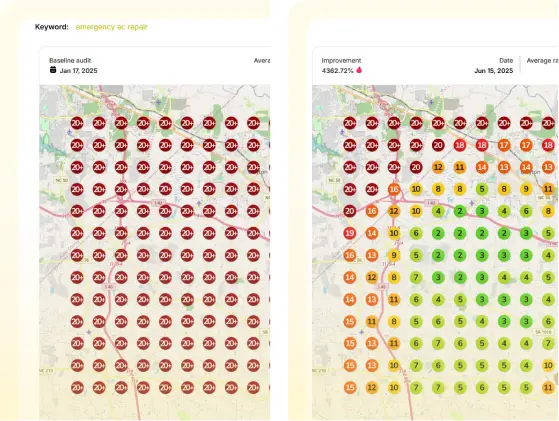
For example, a home services company might notice that demand for "air conditioning repair" spikes in May in one region but not until June in another. If the company runs the analysis yearly, it might miss that shift and launch campaigns too late. Running it monthly means it can see the pattern emerge and prepare ahead of time. That kind of timing advantage compounds over the year.
Finally, the analysis should be shared across the business. Sales teams can use it to prioritise leads. Product teams can use it to decide which features to build. Marketing teams can use it to target campaigns. When everyone works from the same map of opportunity, the business moves in the same direction.
Market opportunity analysis is not a buzzword. It is a practical method for finding demand that others have missed. With the right data and a clear process, any business can uncover growth that was hiding in plain sight.